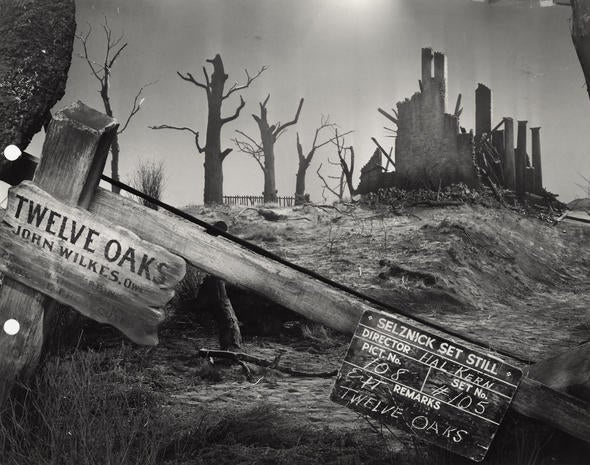
Economic Insights From "Gone With The Wind"


My wife and I recently enjoyed seeing Gone With The Wind projected on a movie screen, a first for us both. We'd seen it on television, but the large screen experience was something quite different. A good many years had passed since I last watched the film, and I was struck by its comedic moments, as well as its more blatant racism and misogyny (times have changed and continue to!)
I was also impressed with its rather solid financial advice. For example, when raising funds for "the Cause" (AKA war), Rhett Butler made an impression on the crowd with an offer of gold for a dance. In times of political turmoil, you know, civil war, regime change and such, precious metals are more desirable than paper money issued by a government that may or may not be in power in days to come. This point is hammered home in a later scene, when Scarlett O'Hara returns home to find the family estate in ruins and her father in shock. He tells her not to worry, as he has money. At first, Scarlett is relieved, but when told the money is in Confederate war bonds, she realizes the family is broke - the government that issued those bonds has fallen and they are worthless. Mr. O'Hara still has a head for permanence, however; he reminds Scarlett that land is a great asset, "it's the only thing that lasts!"
In summary, we're reminded that precious metal bullion is a great hedge in times of turmoil, paper (or digital, as times have changed) currency is backed only by faith and credit in the issuing body and is subject to the fate of said body, and land indeed is the only thing that lasts. I left the theater thinking I need to buy bullion and acreage!
In closing, it was a great night put on at the beautiful GEM Theatre in Calhoun, Georgia, just an hour or so north of the film's setting.

Comments

Popular posts from this blog

Regarding Keeslyn

In January 2020, a young lady named Keeslyn Roberts disappeared from a fuel station near my home. The case remains unsolved. This post will examine the actions, and lack thereof, of those in authority, and how this contributes to the case remaining unsolved. But first, a little backstory. As a teen, I lived in the same neighborhood as the Roberts family. Keeslyn's father, Eric, is older than I, and I don't recall the two of us having much interaction. His sister, on the other hand, is the same age and we've been friends for over 40 years. It was she who told me about Keeslyn's disappearance and the family's frustrations with the lack of police action. To learn more of the specifics of the case, numerous podcasts and news stories are available online. To my understanding, the police reaction to the disappearance has thus far been little to no reaction. After no word from his daughter for several days, Eric went to the fuel station where her car was parked. He th...

Visiting Alice

Savannah, Georgia is one of my favorite cities. Younger than London, older than San Francisco, with a degree of quirk rivaled only by New Orleans, Savannah is a six hour (if Atlanta traffic is agreeable) drive from my home in the northwestern corner of the state.  Comparing my region with that of Savannah is an exercise in futility; they are worlds apart. One is lower Appalachia, with rolling green hills and valleys, creeks and waterfalls. The other is coastal Georgia, low country, wetlands. Even the cultures and accents are sufficiently different as to make a new acquaintance appear surprised when they ask where you're from and you reply "Georgia." Something neither place lacks is ghosts, but you probably knew that, didn't you? View this YouTube video by Dixie After Dark for a bit of info on Georgia's first ghost, Alice Riley. I love writing about Savannah. I can almost see the Spanish moss and smell the pot of low country boil!

How To Beat A Billionaire - Updated

If you've spent any time at all on this site, you will have noticed I have an interest in investing. I had no interest in finance until my mid-40s, when I took a job at a printing company in which one of the partners is a CPA. I learned personal finance the hard way, struggling with credit card debt in my early 20s (it was the 90s; I blame the guitar and camera stores). After digging myself out of the hole I was in by age 27, I was cautious to avoid debt anytime I could. Investing, aside from employer retirement plans, was not on my radar. Fatherhood really spurred me into action when it came to investing. There's simply no way a savings account can outpace inflation; if you want to thrive financially, investing is the best way to get ahead. So, with encouragement from my boss, I began to study and learn. Investopedia and The Balance proved to be immensely helpful. In time, I opened an account and started buying exchange traded funds (ETFs) and was on my way. I read a few...